
Council Reps
Council Representative Information
Roles and Responsibilities
Council Reps are member-elected delegates who work to form union policy and act as union representatives in the workplace. CRs are a vital link between the employees they represent and the employer.
CRs have a number of responsibilities, but most important is to ensure that every SPEEA-represented employee receives union representation whenever necessary.

Key responsibilities and and roles:
- Support members in the workplace
- Attend Council meetings, formulate and vote on union policies
- Contract monitoring and enforcement
- Union representative on Partnership forums
- Assist members with performance issues or who face discipline
- Grievance handling/Investigations/Interviews
- Communicate and inform members on important issues
- Maintain the workplace network
- Recruit new members and help fill union committees
Every odd year, or as vacancies occur, members who wish to serve as their district Council Rep submit a petition and statement to SPEEA. The SPEEA Tellers validate each petition and statement for compliance. An election is conducted if more than one valid petition is submitted for the same Council seat. To serve as a Council Rep, a member must be in continuous good standing for the preceding twelve month period.
Following elections, new Council Reps participate in Basic Training to prepare them for their role. Each year, all CRs receive refresher training at the Leadership Conference and make-up trainings periodically offered at the SPEEA halls.
SPEEA lunchtime meetings
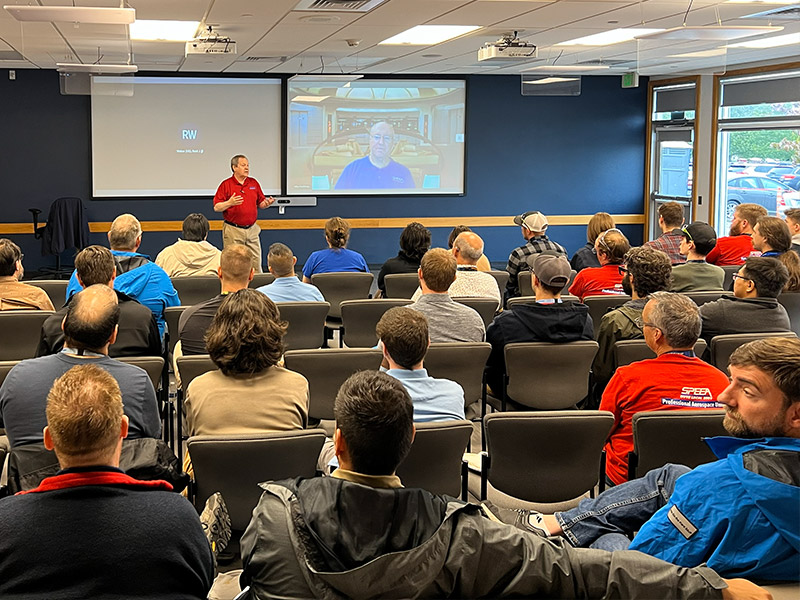
Council Reps are able to schedule lunchtime meetings for training on a variety of topics. See the topics and how to schedule below.
Retirement, Financial Planning and more
To schedule one of these lunchtime meetings presented by Matt Kempf, SPEEA senior director of compensation and retirement email mattk@speea.org.
- Boeing Pension and Retirement
- Early/Mid-Career Financial Planning 101
- How to Use Financial Engines™
- Intro to Negotiations
- Medical, Dental, & Benefits 101 (Spirit AeroSystems)
- Open Enrollment (Spirit AeroSystems)
Benefits and Open Enrollment
To schedule a lunchtime meeting related to benefits or open enrollment at The Boeing Company, email SPEEA Benefits Coordinator Jason Collette at jasonc@speea.org.
- Medical, Dental, & Benefits 101 (The Boeing Company)
- Open Enrollment (The Boeing Company)
Other topics of interest
Contact your SPEEA Contract Administrator to schedule a lunchtime meeting for the members in your district on any of the following topics. If there's a topic of interest not listed, be sure to ask your Contract Administrator about it.
- How to Pursue an Upgrade
- Layoff Benefits
- Performance Management: Define, Interim Review and/or Close-out
- SPEEA 101
- SPEEA Salary Charts
- Taking Time Off
- Understanding NORAs
- Understanding the Retention-Rating Process
- Understanding Your Contract





Your Rights at Work
Weingarten Rights
A union-represented employee has a right to be represented during an investigatory interview. The interview could be in person, by telephone or by email. A supervisor or human resources representative normally conducts this interview. Should a represented employee be asked questions of an investigatory nature, they should immediately request their SPEEA Council Representative be present before answering any questions.
A member's response to any request or circumstance:
“I am respectfully invoking my Weingarten Rights and am requesting to have my SPEEA Council Representative present prior to answering any of your questions. Please let me know how you want to proceed.”
Seven Standards of Just Cause
SPEEA contracts are clear that all discipline of a represented employee meet the Standards of Just Cause:
- Was the employee aware of the rule and the consequences of violating that rule?
- Was the employer’s rule or order reasonably related to efficient and safe operations?
- Did management investigate before administering discipline?
- Was the investigation fair and objective?
- Did the investigation produce substantial evidence of proof of guilt?
- Were the rules, orders, and penalties applied evenhandedly and without discrimination?
- Was the penalty reasonably related to the seriousness of the offense and the past record?
